China’s big tech governance model looms over Alibaba’s lawsuit against the Pentagon
Originally published on Global Voices
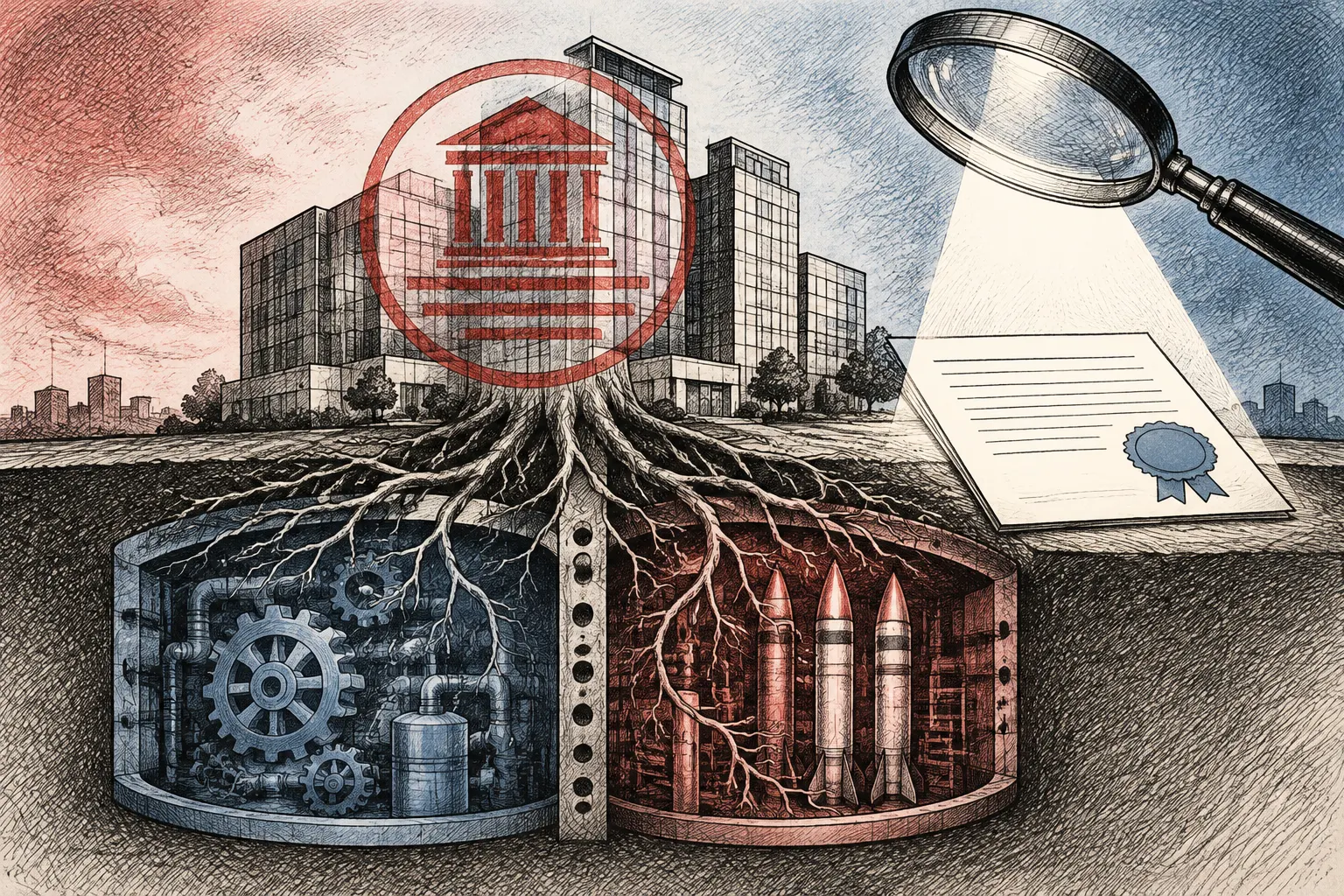
Image created by Oiwan Lam with Canva.
This post is part of Global Voices’ October 2026 Spotlight series, “Big Tech and Authoritarianism.” In this Spotlight, we explore how Big Tech facilitates and hinders authoritarian governments and practices, and how these choices influence the Global South. You can support this coverage by donating here.
As the U.S. Department of Defense expanded its Section 1260H list of “Chinese military companies operating in the U.S.” in June 2026, three dominant internet and technology giants — Baidu, Alibaba and Tencent (BAT) — have been flagged as an extension of the Chinese state and subject to the Pentagon procurement ban that excludes them from DoD’s supply chain. The listing also signals an increasing risk of further sanctions from the Department of Commerce or the Treasury.
Alibaba protested the classification by suing the Pentagon. In the court filing, Alibaba denied any affiliation with the Chinese military or any role in China’s state-directed military-civil fusion strategy. It argued that the listing and ban “has no basis in fact or law” and deprives the company of future business opportunities. It also argues that the abrupt announcement has violated the company’s constitutional right to explain its position.
Section 1260H was introduced in 2021 to address the so-called Chinese state strategy of “military-civil fusion,” which facilitates the transfer of commercial tech companies’ technology or research to Chinese defense bases. The DoD’s statement describes Alibaba as “indirectly affiliated with SASAC” (State-owned Assets Supervision and Administration Commission of the State Council of the People’s Republic of China), and a “military-civil fusion contributor to the Chinese defense industrial base” because it is affiliated with China’s Ministry of Industry and Information Technology (MIIT).
Setting aside the debate over procedural justice, the public records — mostly international and Chinese domestic news reports — that the DoD submitted to the court as evidence of its decision largely reflect the authoritative nature of China’s big-tech governance, highlighting Alibaba’s strategic alignment with the Chinese government’s censorship, technology, and military development strategy.
Law and business
Citing news reports about China’s censorship and Alibaba’s official document about its milestone in tech development in its submission to the court, DoD suggests the company plays an active role in building China’s censorship regime.
Indeed, China has more than a dozen laws and regulations. The Cybersecurity Law (2017), for example, requires network operators to monitor, halt, and delete prohibited content; preserve logs; and report incidents to government authorities. Provisions on the Governance of Cyber Information Content Ecosystem (2020) classify content into three major categories: positive, illegal, and negative, and demand that operators promote, delete, and suppress them accordingly. AI-related laws ban the use of algorithms to “influence public opinion” or encourage addiction/overconsumption, and ensure generative AI models adhere to the state’s “core socialist values.”
Alibaba argued that compliance with Chinese regulations should not be interpreted as evidence of military ties, since all multinational companies operating in China, including American firms, must follow local laws.
However, the Pentagon’s public record attachment to the court suggests that Alibaba not only adheres to the censorship requirements in its consumer platforms, generative AIs, and mobile browser, but also develops censorship technology such as Alibaba “Green AI,” which automates real-time filtering across text, images, voice, video, and streaming data, and sells the content moderation tools to both domestic and overseas developers, e-commerce vendors, video streaming services, and gaming platforms, so that they can operate within China’s legal requirements.
Alleged affiliations and strategic alignments
Beyond assisting and exporting censorship technology, which is not for military purposes, the DoD’s court filing also includes news reports and commentary about the disappearance of its founder, Jack Ma, in late November 2020.
Prior to Jack Ma’s disappearance, on October 24, 2020, he criticized China’s banking system as being outdated, and later, on November 3, Alibaba’s Ant Finance’s USD 37 billion dual listing in Shanghai and Hong Kong stock markets was suspended. His disappearance coincided with the Chinese authorities’ antitrust investigation against Alibaba, which was eventually fined USD 2.75 billion for forcing merchants to choose between platforms.
The DoD also suggested Alibaba’s “indirect affiliation” with SASAC and military ties through the company’s joint venture profile, in particular its joint venture with Norinco Group, a Chinese state-owned military company sanctioned by the U.S. Department of the Treasury, in establishing Qianxun Intelligence, which develops a spatial intelligence AI that uses the Beidou Navigation Satellite System and ground stations to deliver precise positioning for smart cars, drones, and mobile devices. Beidou is owned and operated by the China National Space Administration.
Although Alibaba relinquished its 50 percent share in Qianxun Intelligence in 2018, allegedly, its executive members still control a large stake, and Alibaba still relies on Qianxun AI for its commercial products.
The DoD also noted that Alibaba partnered with China Mobile, a Chinese state-owned enterprise, to build data centers for cloud computing and AI. As Alibaba increasingly invests in these sectors, this partnership will likely only grow stronger, as such technologies heavily rely on data centers and geospatial technology — all of which are strategic sectors under the Chinese government’s national security framework. Since 2026, Alibaba has entered a new power plant joint venture in coastal Ningbo city with state-owned China National Nuclear Power Co. to secure a stable electricity supply for its future data centers’ needs, and last month it acquired a stake in state-owned Shanghai Spacecom Satellite Technology to develop Qianfan Constellation (千帆星座), a low-Earth-orbit broadband constellation similar to SpaceX’s Starlink for its geolocation products.
As a private company dual-listed in the U.S. and Hong Kong stock exchanges, Alibaba is not under SASAC supervision; however, amid the China-U.S. tech race, Alibaba’s investments inevitably fall into strategic areas that require working with state-owned corporates. The DoD argues these ties include indirect affiliation with SASAC, catering to China’s civil-military fusion strategy.
Moreover, some of Alibaba’s subsidiaries, including Shanghai-based Youku Film and Television (video streaming) and Guangzhou Lujiao Information Technology Co., Ltd have “golden shares” arrangements with state-owned enterprises backed by China Internet Investment Fund (CIIF) set up by the Cyberspace Administration of China (CAC) to strengthen the board-level management of Alibaba’s content platforms.
The DoD cites the inclusion of high-level representatives from Chinese big tech, including Alibaba, Baidu, Huawei, and Tencent, in China’s AI Standardization Technical Committee under the MIIT as evidence of Alibaba’s direct ties to the Chinese government.
Citing analysis from the Chinese Communist Party (CCP) newsletter, Qiushi (求是), and various China observers from the West, the DoD’s argument is that Alibaba’s investment and development are strategically aligned with the Chinese government policy, which includes the installation of AI technology into its military hardware, the strategy of hosting data centers in western regions, building the space computing infrastructure, and more.
Indeed, not only is big tech like Alibaba confined by the government; Chinese regulators’ sudden call-off of Facebook’s acquisition of Manus, a Chinese AI start-up, earlier this year reflects China’s fervor to secure and control its technology sector.
China’s big tech governance model
The current Chinese big tech governance model stems from decades of stability-control experience aimed at securing the single-party regime through censorship, surveillance, party-building, and ideological control. Whereas the development of AI has triggered anxiety surrounding automated crimes such as AI-hacking and unemployment in the West, China sees AI simply as a governable tool. For example, in response to waves of delivery workers’ strikes against AI pressure in recent years, in parallel with crackdowns and arrests, regulators also summoned representatives from major platforms, including Jingdong, Meituan, and Taobao, and instructed them to adjust their algorithms, abolish late delivery penalties, introduce rest time, and encourage labor-platform negotiations.
Taobao, Alibaba’s domestic shopping platform, has thus far established more than 300 party branches for 300,000 Taobao delivery workers, and, through these branches, provides on-the-job training, cheap accommodation and meals for workers in need, which is indeed a merit for the working class.
In the ongoing court case, Alibaba argues against the DoD allegations, saying the company follows both Chinese and U.S. laws and is managed by an independent board of directors with no military affiliation. It also stresses that its core business, including cloud services, e-commerce, and logistics, serves commercial businesses and individual consumers rather than the military sector.
The case would test the U.S. government’s stance on the Chinese big-tech governance model. Tencent and Baidu have not yet filed any appeal to be delisted from DoD’s 1260H sanctions list.
Written by Oiwan Lam