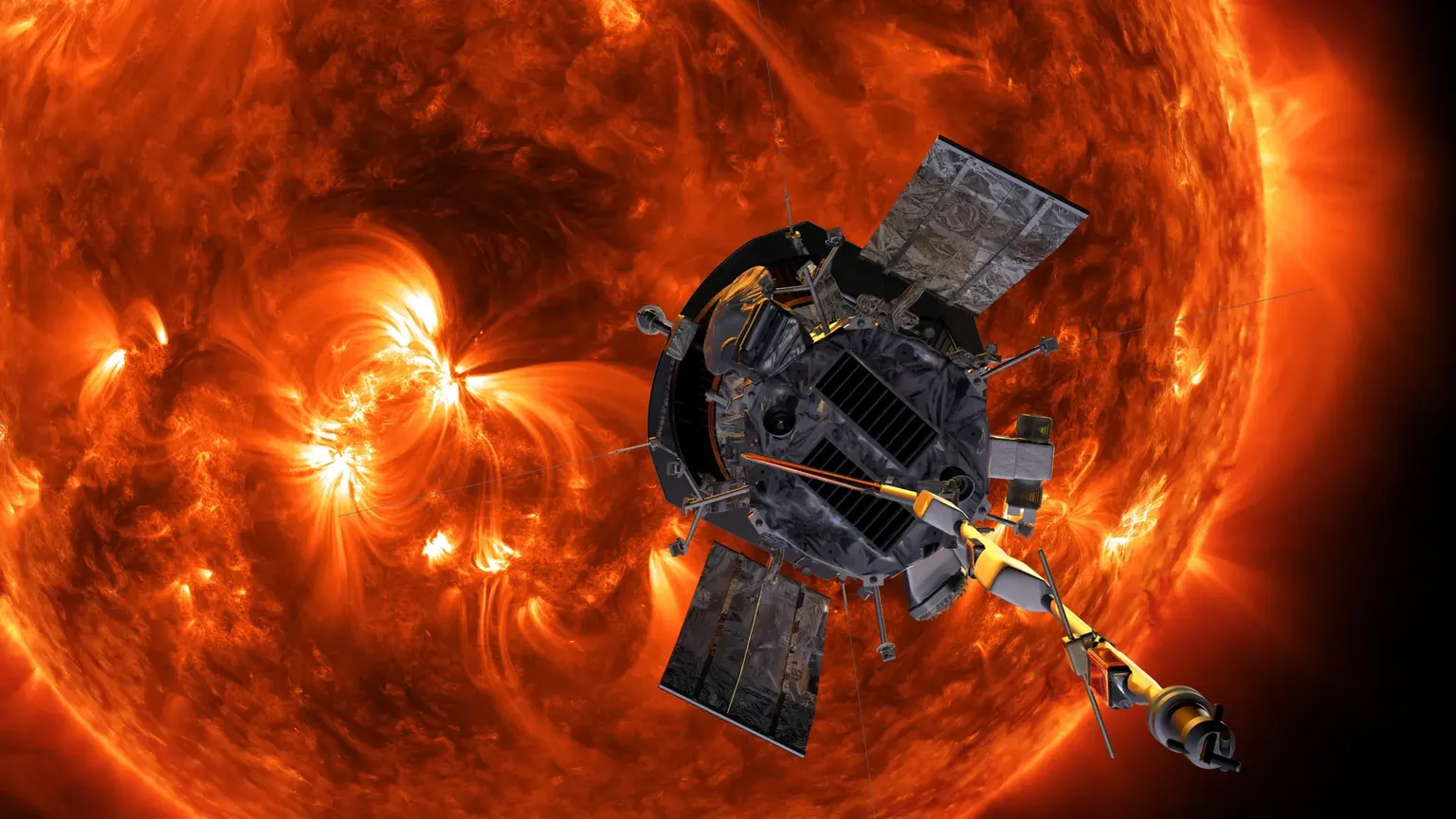
Turbulence in space can look like random noise. Measurements from NASA's Parker Solar Probe show a magnetic pattern hidden inside it, one that reverses direction at very small scales. According to an international team of researchers, turbulent magnetic fields in the solar wind change their direction of rotation within a specific range of wavelengths. The team describes this as the first time such a reversal has been observed directly in space turbulence. The findings appear in The Astrophysical Journal Letters. Distance from the Sun affects the flip. The farther the solar wind travels, the stronger the reversal becomes, and it moves toward longer wavelengths. From counterclockwise to clockwiseThe direction of rotation is the most clear-cut part of the finding. Looking along a line that points away from the Sun, magnetic fields at larger scales usually rotate counterclockwise. At far smaller scales, they tend to rotate clockwise instead. This change occurs where plasma shifts from acting mostly like a fluid to acting according to how its individual particles move. Because of where it happens, the researchers believe the reversal could offer physicists a fresh method for studying turbulence across different physical scales."We see a clear structure in the spectrum, even though the turbulence represents unstructured motions," said Dr. Masatomi Iizawa of TU Braunschweig, the study's first author. Why turbulence in space is tougher to model than coffeeTurbulence on Earth is familiar: milk spiraling through a cup of coffee, or storms crossing the atmosphere and the oceans. In space, the picture changes, and scientists have not yet fully explained it. Most matter in space is plasma, made up of particles that carry an electric charge. These particles respond strongly to magnetic and electric fields, so the turbulence they generate works in a fundamentally different way from turbulence in air or water. Space plasma is also so sparse that its particles seldom collide, which makes it behave in even less familiar ways. On larger scales, plasma flows much like a fluid. Vortices and electromagnetic waves pile up into fluctuations of growing complexity. For a long time, researchers have tried to understand how turbulence forms in these conditions and how energy spreads across fluctuations that are always changing. The new study does not answer that question. What it does show is an ordered feature within a system that is otherwise full of fluctuations that appear unpredictable."The results are of great significance for both plasma physics and astrophysics," said Dr. Yokoi of the University of Tokyo. How this connects to geomagnetic stormsAlthough the reversal takes place at extremely small scales, plasma turbulence appears in many settings. These include Earth's magnetosphere, the solar wind, areas affected by solar eruptions, interplanetary space and the accretion disks of material around some astronomical objects. Turbulence also affects the shock waves and clouds of magnetic material that travel through interplanetary space after the Sun erupts. Those disturbances can matter a great deal for geomagnetic storms, which makes turbulence a factor in predicting space weather. The researchers said their results may in time help scientists understand the processes behind the solar wind and refine the physical models used to forecast geomagnetic storms. That goal is a long way off. The paper adds one piece to the puzzle and does not offer a new forecasting tool. The team behind the studyResearchers from Technische Universität Braunschweig and the University of Tokyo identified the phenomenon, working alongside Tohoku University, Kyushu University, Osaka University and other international institutions. Scientists from 10 countries took part, including researchers at the Institute of Theoretical Physics at TU Braunschweig. The team worked with highly precise magnetic field and particle measurements collected by Parker Solar Probe. The rotation flip lies at the boundary between fluid behavior and particle behavior, and it strengthens as the solar wind moves farther from the Sun.
Science
Parker Solar Probe data shows solar wind magnetic fields switching rotation at small scales